




If you’ve noticed your pool losing water and you’re thinking about calling a professional, one of the first questions you’ll ask is: how much is this going to cost? It’s a fair question — and an honest answer requires more than a price range. It requires understanding what you’re actually paying for, what separates a thorough inspection from a rushed one, and why the cheapest option often ends up being the most expensive choice you can make.
This article breaks down pool leak detection pricing from the inside — what the work actually involves, why costs vary, and what to look for when evaluating a leak detection company.
What Pool Leak Detection Actually Involves
A legitimate pool leak detection visit is not a single test. It’s a systematic process of elimination that moves through the pool’s plumbing, structure, and equipment until the source of the water loss is confirmed — not guessed.
At Aquatrace, every visit is planned around the full range of detection methods. Not every test will be needed on every job — a straightforward skimmer leak may be confirmed quickly through visual inspection and dye work alone. But we don’t stop there. We test EVERYTHING. We arrive prepared to perform any and all of the following, and we don’t stop at the easy answers if the easy answers don’t hold up.
A thorough inspection draws from some combination of these methods:
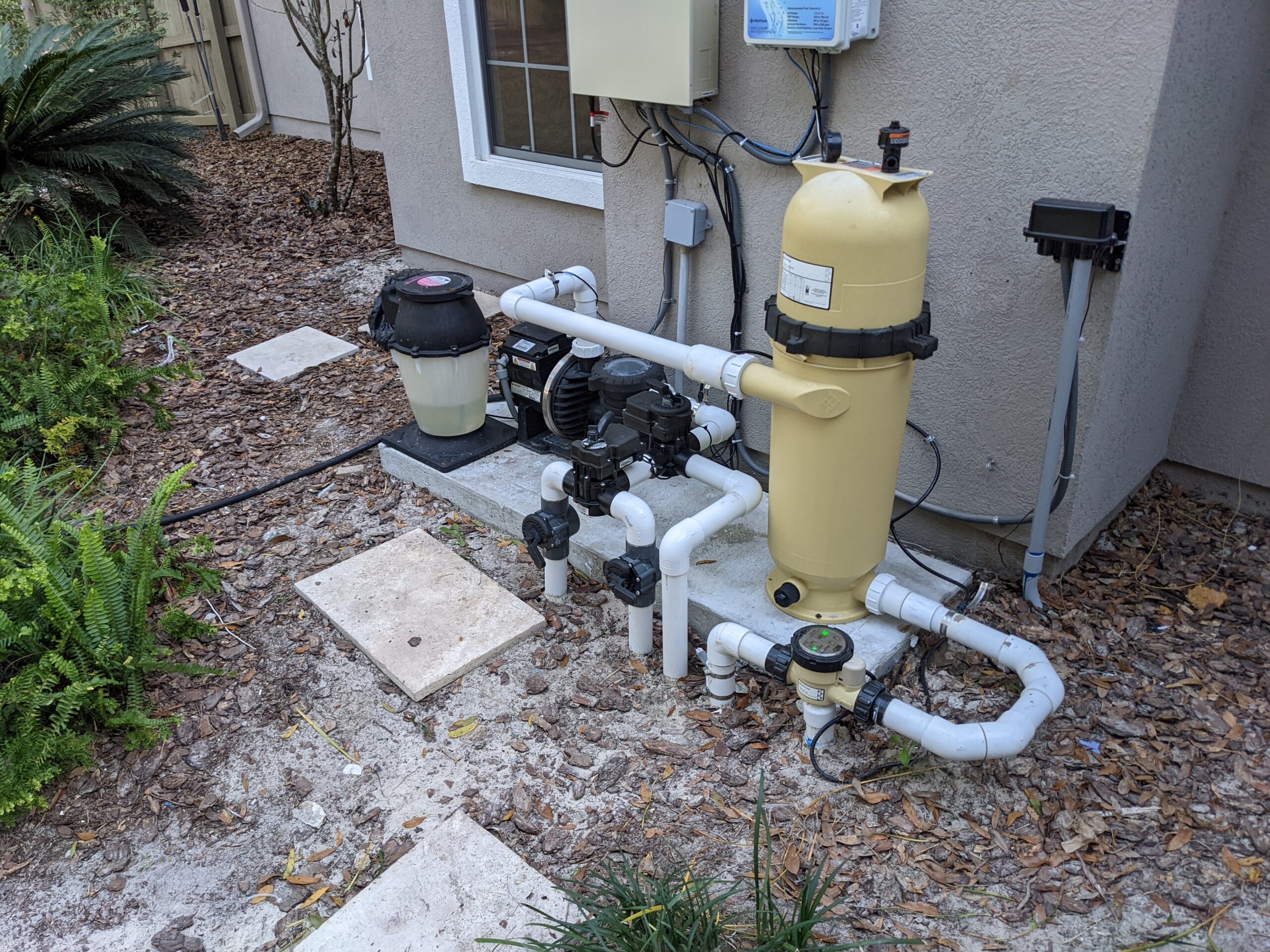
A visual inspection of all visible equipment, plumbing connections, fittings, valves, and the pool shell — looking for wet spots, corrosion, erosion, or obvious signs of failure.
A bucket test or water loss confirmation to establish whether the pool is actually leaking and at what rate.
The pump-on/pump-off assessment, on occasion, to determine whether water loss is greater with the pump running or off — which can sometimes narrow the leak to either the pressure side or suction side of the plumbing system, or points toward a structural leak in the shell.
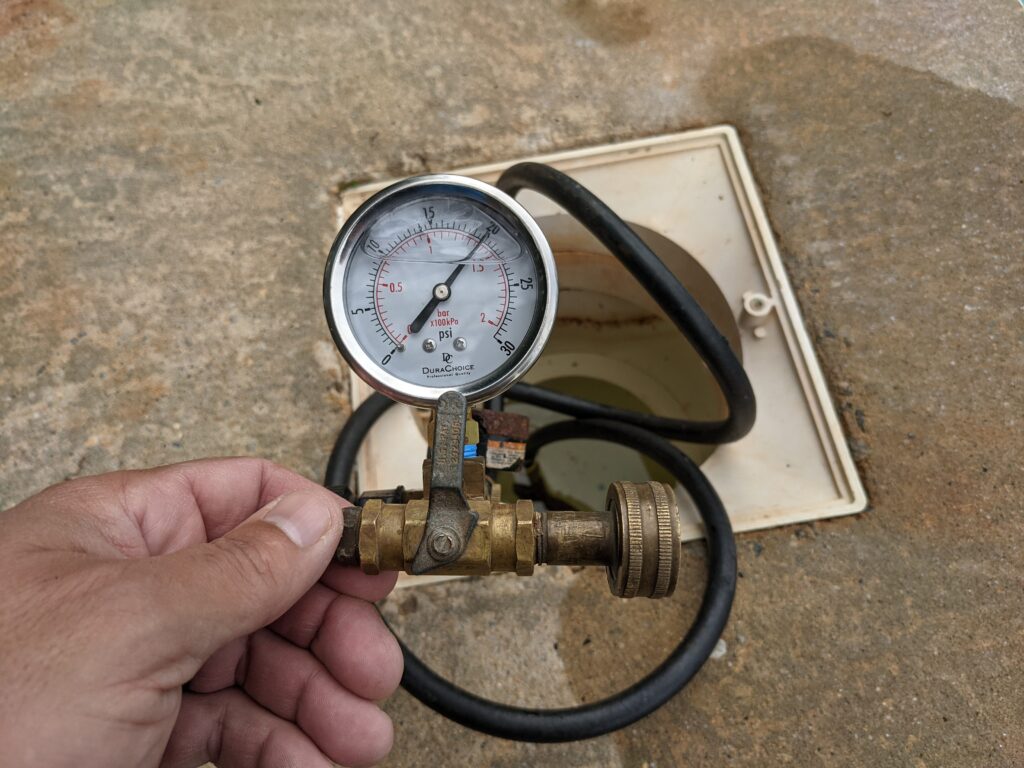
Pressure testing of suspect plumbing lines, which involves isolating individual pipes, introducing compressed air or gas at controlled pressure, and monitoring whether that pressure holds. A line that loses pressure has a leak somewhere along it.
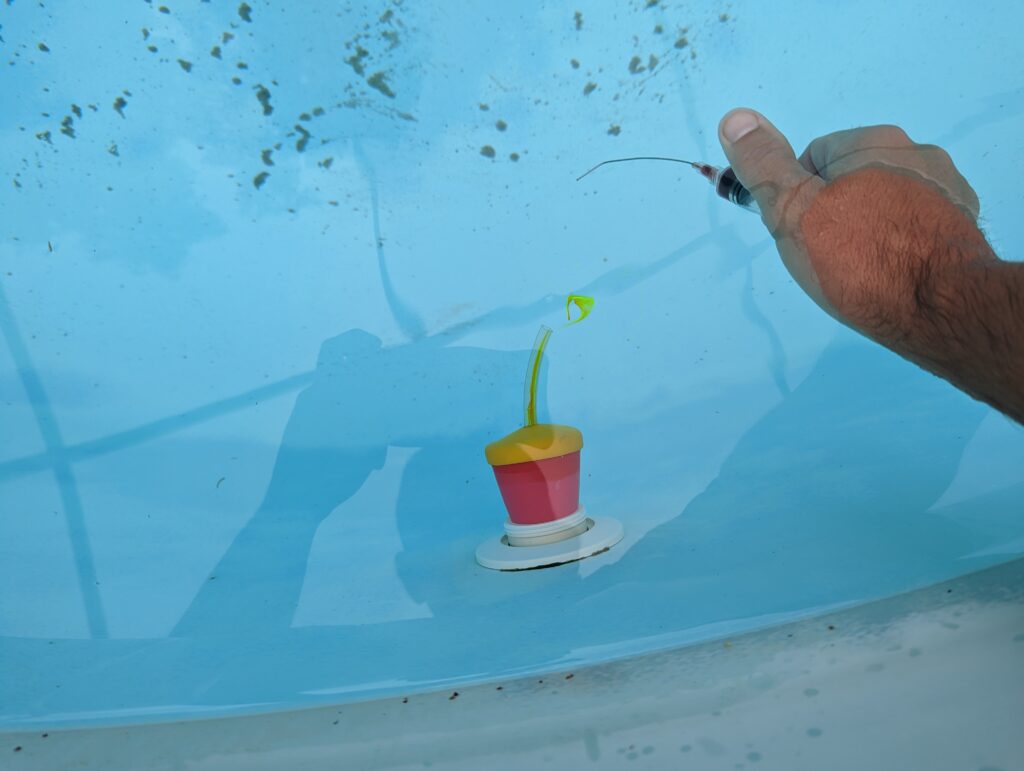
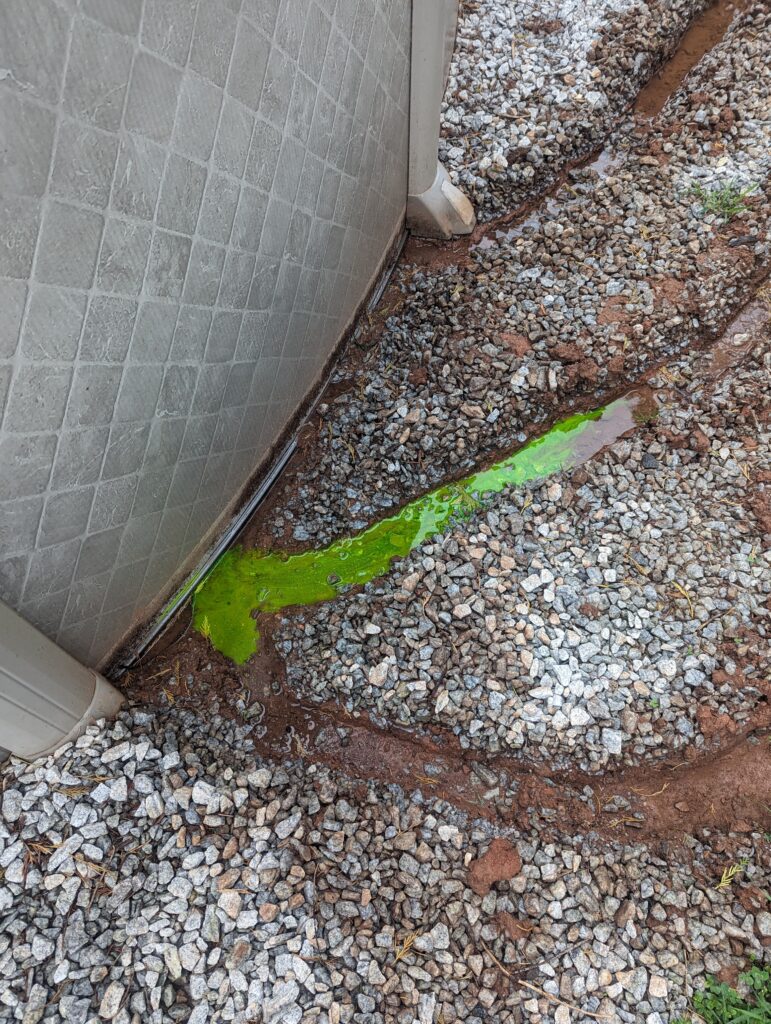
Dye testing around fittings, penetrations, the skimmer throat, light niches, return jets, and any visible cracks — using dye injected into still water to visually confirm where water is being pulled out of the pool.
Acoustic detection using hydrophone listening equipment — specialized devices that detect the sound of water escaping underground through pipe walls or cracked fittings — to pinpoint the exact location of an underground leak before any digging begins.
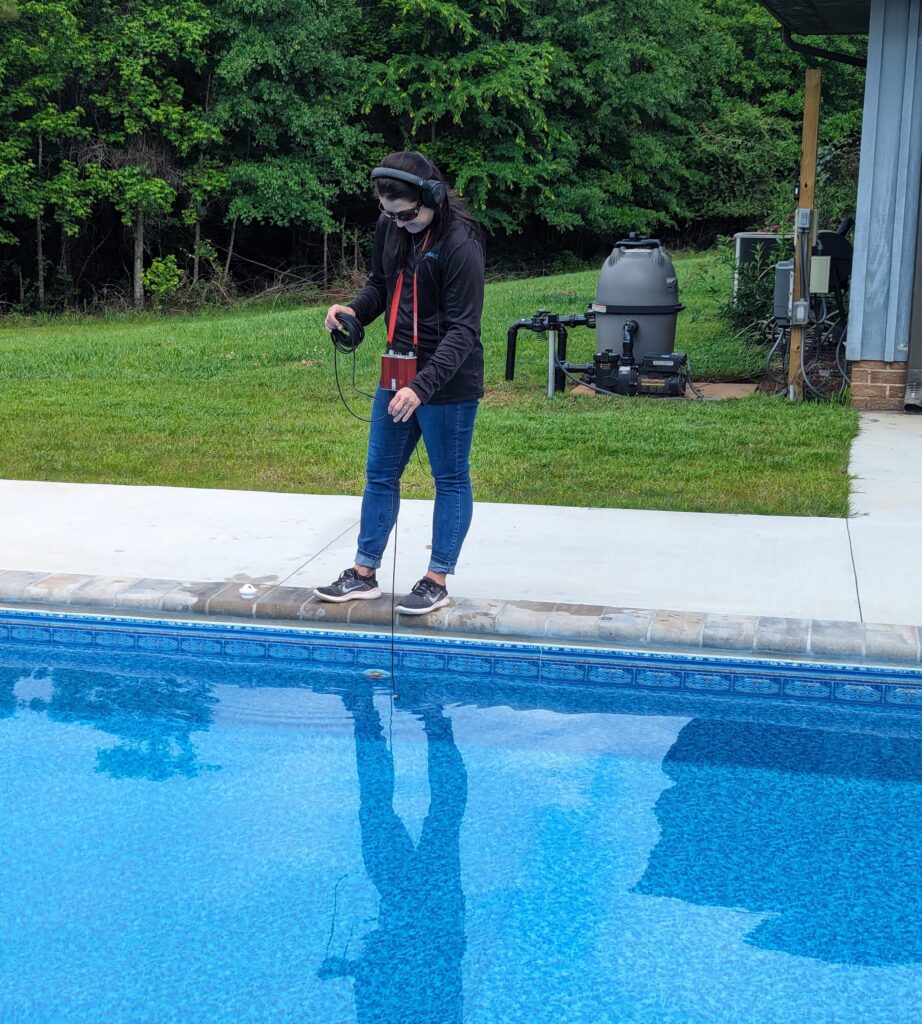
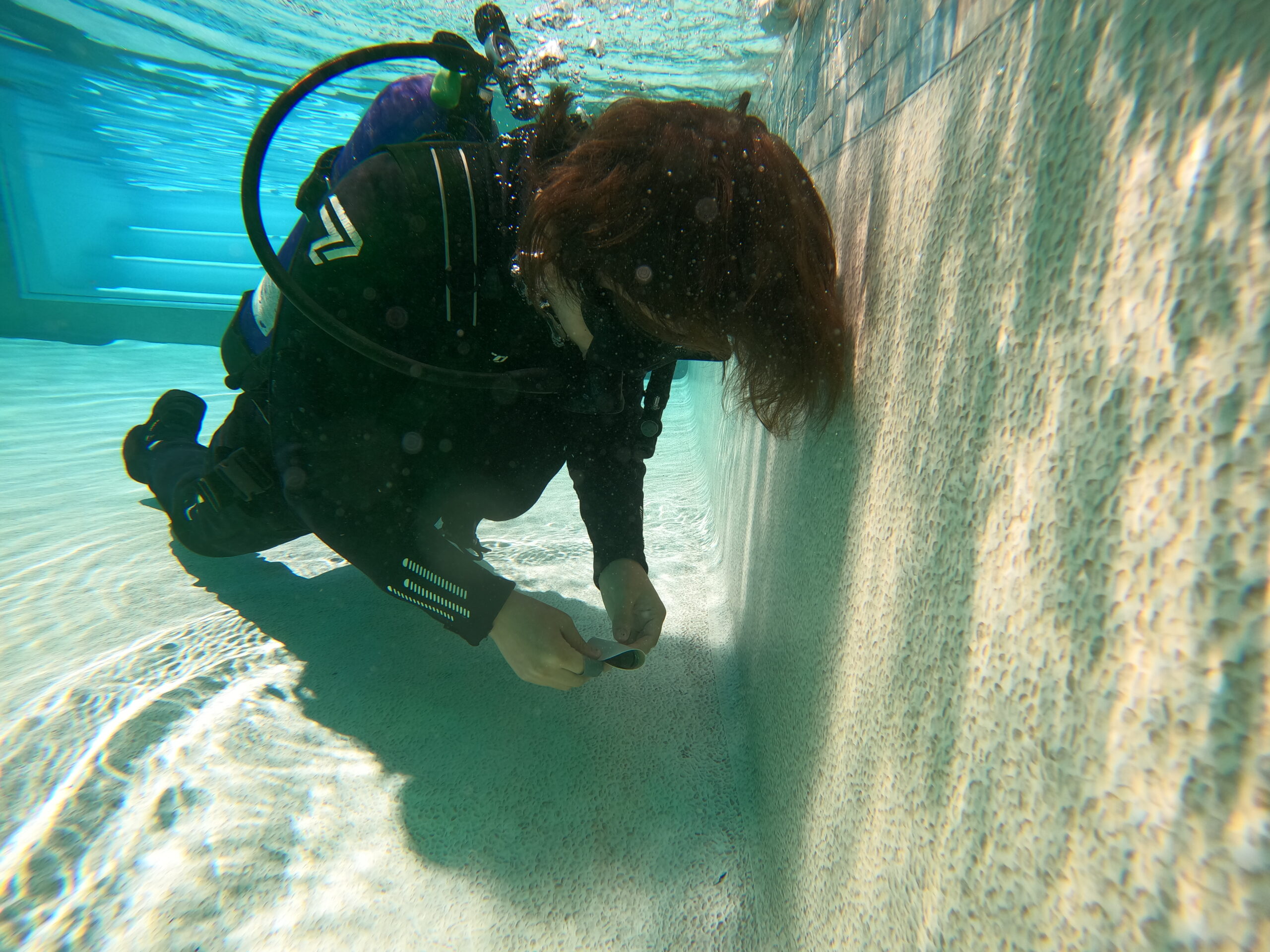
SCUBA-assisted underwater inspection for main drain areas, floor penetrations, and structural issues that cannot be reached or clearly seen from the pool deck.
That last item deserves a more honest conversation than most pool leak detection companies are willing to have.
What SCUBA Detection Actually Costs — in More Ways Than One
Most pool owners picture SCUBA detection as a warm-weather exercise. A diver slips into a backyard pool on a summer afternoon, takes a look around, surfaces with an answer. And sometimes it is exactly that.
But pool leak detection is a year-round service. Leaks don’t pause for winter. A pool losing water in January in the Carolinas or North Carolina mountains presents a very different physical environment than the same job in July. Water temperature in an unheated residential pool in winter can drop into the low 40s Fahrenheit, or lower — cold enough to cause meaningful physiological stress on a diver within minutes of entry.
Cold water immersion is not simply uncomfortable. It triggers an immediate physiological response in the human body: the cold shock response causes an involuntary gasp reflex and rapid breathing in the first seconds of entry, followed by progressive cooling of the extremities, reduced manual dexterity, impaired judgment, and — in extended exposure — the early stages of hypothermia. A diver working in a 42-degree pool in winter is not in the same physical situation as a swimmer in a sun heated backyard pool in August. They are managing real physiological stress while simultaneously performing precise diagnostic work.
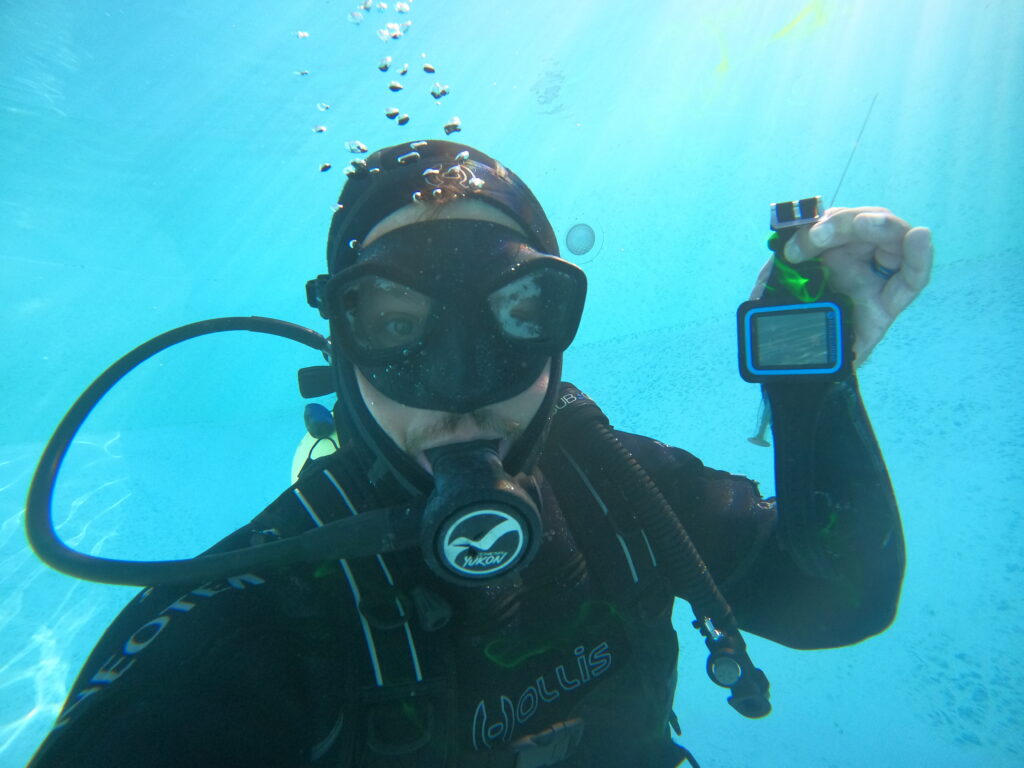
This is why SCUBA capability in a professional context is not simply a matter of owning a wetsuit and a tank. At Aquatrace, our dive team holds multiple NAUI certifications and NAUI leadership recognition — NAUI stands for the National Association of Underwater Instructors — and our founder, Chris Sears, is a NAUI-certified dive instructor who founded and operates Dive Factor, a dedicated dive operation. The team is trained not just to dive, but to dive safely in conditions that are not always forgiving.
In certain situations — particularly cold water dives, pools with limited visibility, or jobs requiring extended underwater time — safe diving practice calls for a two-person dive team. One diver works. The other monitors from the surface or serves as a safety diver. This is not inefficiency. It is standard protocol that reflects the genuine physical risks involved in underwater work. When Aquatrace deploys a two-person team for a cold water inspection, that reflects the same level of professional planning you would expect from any trained dive operation.
NAUI certification is not a weekend course. It requires classroom instruction in dive physics, physiology, and decompression theory; open water training; demonstrated proficiency in controlled and emergency procedures; and ongoing recertification. The skills being applied on a cold January pool inspection are skills that took years and significant personal investment to develop — and they are skills that the technician is quite literally putting their body on the line to use.
When a customer looks at a pool leak detection invoice in the winter and thinks “I’m paying for someone to swim in my pool” — the honest answer is: yes, partly. And also, they’re doing something that requires real training, carries real physiological risk, and is being performed systematically and safely because that is what the job demands to be done right.
What Does Pool Leak Detection Cost?
For a standard residential inground pool, professional leak detection typically runs between $300 and $600. That range reflects most straightforward inspections where the leak is found through visual inspection, pressure testing, and dye work without complications.
Costs move higher — toward $700 to $1,000 or more — when the pool is large, has a spa or water features attached, requires extensive plumbing pressure testing across multiple lines, involves cold water conditions requiring additional safety protocols, or when the leak is in an unusual or difficult location that requires more time and specialized equipment to confirm.
Costs move lower when the inspection is limited — fewer tests performed, fewer lines checked, less time on site. This is where the price range can be misleading. A $150 pool leak detection visit and a $500 pool leak detection visit are not the same service. The difference is almost always in what the company is willing to do, what equipment they bring, and what standards they hold themselves to when the conditions are difficult.
What is not included in the detection fee is the repair itself. Detection and repair are two separate services. Detection finds and confirms the leak location. Repair fixes it. Most straightforward temporary repairs — a skimmer throat seal, a return fitting, an accessible pipe joint, a puncture in a vinyl liner — can be completed the same day at reasonable additional cost. Underground plumbing excavation along with more substantial repair needs, if required, is a separate estimate.
Why Does Pool Leak Detection Cost What It Does?
The equipment alone runs into thousands of dollars. Hydrophone acoustic listening systems, pressure testing rigs, dye injection kits, and professional SCUBA gear — including wetsuits rated for cold water, regulators, tanks, and safety equipment — are not inexpensive. A company investing in proper detection equipment is passing some of that cost to the customer. What the customer gets in return is accurate, confirmed results rather than a semi-educated guess.
Beyond equipment, the cost reflects the technician’s training and experience. Reading a pressure gauge is straightforward. Interpreting the sound of an underground leak through a hydrophone, distinguishing a structural leak from a plumbing leak using dye behavior in moving water, performing a safe cold water dive and conducting precise diagnostic work simultaneously — these are skills that take years of field experience to develop reliably. They are also skills that the company has invested in building, maintaining, and certifying.
Time on site also matters. A pool with a single obvious skimmer leak may be confirmed and located in under an hour. A pool with no visible signs, multiple plumbing lines to pressure test, and an underground leak in an unexpected location may take two to three hours of systematic work before a definitive answer is reached. When a cold water dive is required and a two-person team is deployed, the time and staffing requirements increase accordingly.
Travel Time Is Part of the Cost — and It Should Be
One factor pool owners rarely think about until they see the invoice is travel. A leak detection company is a service business, and like every service business, the time a technician spends getting to your property is working time that has to be accounted for.
For a specialist serving multiple markets across a wide geography — as Aquatrace does across South Carolina, Georgia, North Carolina and Florida — a service call can involve two hours or more of travel each direction. That’s technician labor, fuel, and vehicle operating costs before a single test has been run. A round trip of that distance on a single job can represent several hundred dollars in travel cost alone, and that cost is real regardless of how quickly the leak is found once the technician arrives.
This is not unique to pool leak detection. Any specialized service that requires trained professionals and specific equipment to physically travel to a job site — plumbers, electricians, HVAC technicians — prices travel time into their work. The difference is that pool owners sometimes have a reference point of “the pool guy” showing up for a $75 maintenance visit, and professional leak detection is a fundamentally different category of service.
There is also a less obvious dimension to travel cost that works in the customer’s favor. When Aquatrace mobilizes for a job, we arrive with the full range of detection equipment — pressure testing rigs, hydrophone acoustic gear, dye kits, SCUBA equipment — everything needed to complete a thorough inspection in a single visit regardless of what the job turns out to require. That mobilization has a cost, but it also means one visit. Not a first visit where the obvious things are checked, followed by a callback when those don’t explain the water loss, followed by another callback when a different piece of equipment is needed.
The goal at Aquatrace is to arrive prepared to find the leak the same day, every time. That approach has a cost built into it. It also means pool owners aren’t paying for multiple partial visits that collectively cost more than a thorough inspection done right the first time.
What Separates a Real Inspection from a Guess
Not every company that offers pool leak detection performs the same level of service. Here are the questions worth asking before you book:
Do you pressure test the plumbing lines, or do you rely on observation and dye testing only? Pressure testing is the only way to definitively confirm or rule out an underground plumbing leak. A company that skips it cannot tell you with certainty that your plumbing is intact.
Do you use acoustic listening equipment? For leaks that are underground and away from obvious failure points, hydrophone detection is what allows a technician to mark a specific spot on the deck and say “dig here” — rather than opening a large area and hoping to find the break.
Do you have certified dive capability for underwater inspection? If your pool has a main drain leak, a floor crack, or a structural penetration that can’t be reached from the deck, a company without dive capability cannot complete a full inspection. Ask directly.
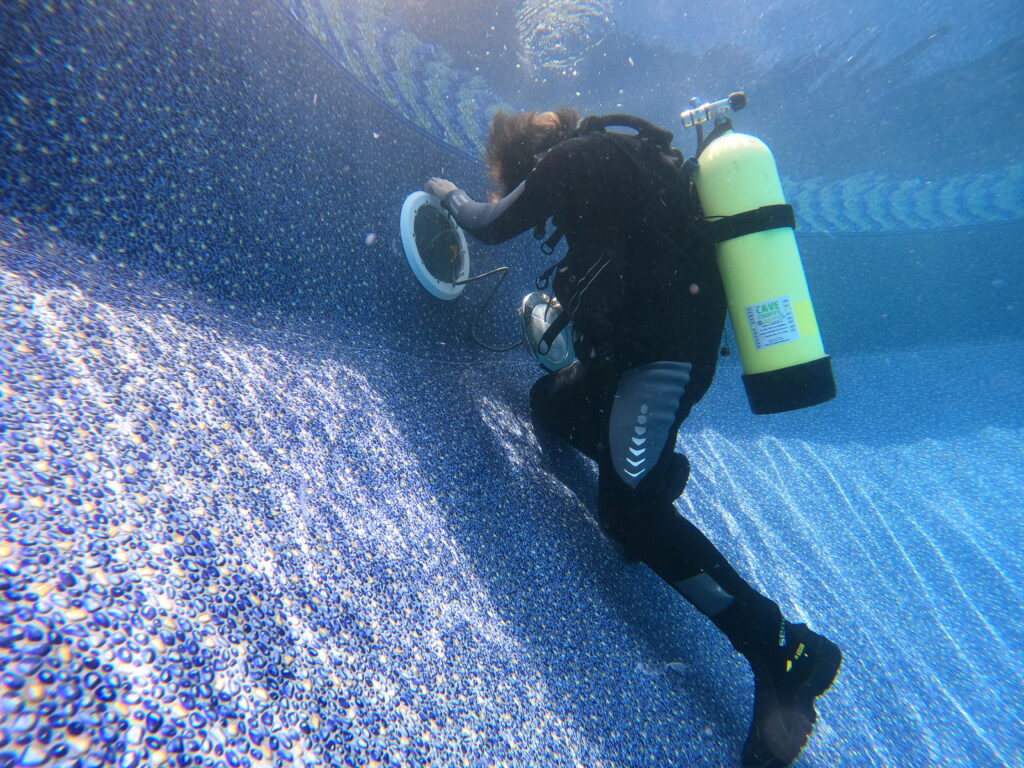
What happens if you don’t find the leak? At Aquatrace, if a leak is present, we will find it. That confidence comes from over 30 years of field experience, a full suite of detection equipment, and NAUI-certified dive capability for the inspections that require going underwater to get a definitive answer.
What is included in the quoted price? Get clarity on whether the quote covers pressure testing all lines, dye testing, acoustic work, and underwater inspection if warranted — or whether those are add-ons that appear later.
Pool leak detection is one of those services where you get exactly what you pay for. Aquatrace is not the cheapest option in the markets we serve, and we don’t claim to be. What we do claim is this: we follow up after the rest. A cut-rate leak detection visit that doesn’t find the leak — or worse, misidentifies it — doesn’t save money. It delays the answer while the leak continues running. When Aquatrace gets called in after another company has already tried and come up short, the customer ends up paying the Aquatrace rate anyway. The difference is they’ve also already paid for the visit that didn’t work. Hiring for quality the first time isn’t the expensive choice. It’s the cheaper one.
The Cost of Not Finding It
A pool leak that goes undetected or is misdiagnosed is not a neutral outcome. Water loss from even a modest leak adds up quickly — hundreds of gallons per day in some cases, with the associated cost of water, chemicals to rebalance a constantly diluted pool, and the pump running harder to compensate for lost prime.
More significantly, underground leaks saturate the soil around the pool shell over time. That saturation causes the ground beneath and around the pool to shift, which stresses the shell, cracks plumbing, and in serious cases contributes to structural movement that makes a simple leak detection visit look very inexpensive by comparison. A leak found early and repaired promptly is nearly always far less costly than one that has been slowly damaging the pool and its surroundings for a season or more.
What to Do Before You Call
A few things you can do before scheduling professional detection that will make the visit more productive:
Try to get an idea of how much the pool is dropping. Is it one inch daily? Is it three inches weekly? And has it ever dropped and stopped at a certain level? These are great pieces of information for your technician to have.
Run the pump-on/pump-off test over 48 hours and note whether water loss is greater with the pump running or off. This gives the technician a starting point before they arrive.
Note where the water level stabilizes if you stop topping off the pool. Keep in mind that where the water stops is not always where the leak is — water can equalize behind the shell or be temporarily slowed by debris — but it is still useful directional information.
Turn off any auto-fill device so that water loss is visible and measurable.
Make sure the pool water is clean and clear before the visit. Murky water limits the effectiveness of dye testing and underwater visual inspection significantly.
Note anything unusual — air bubbles from the returns, wet spots in the yard, a constantly running auto-fill, chemical imbalances that appeared suddenly. All of it helps.
Once you’ve gathered that information, we’re ready to put it to work — Contact Us to schedule your inspection.
Frequently Asked Questions
Most residential inground pool leak detection visits run between $300 and $600 for a standard inspection. Costs increase toward $700 to $1,000 or more for larger pools, pools with attached spas or water features, situations requiring cold water dive protocols with a two-person safety team, or leaks in difficult locations requiring extensive testing across multiple methods. The price reflects equipment, certified technician training, and the thoroughness of the inspection. Commercial pools can be expected to have much higher customized pricing.
No. Detection and repair are separate services. Detection confirms where the leak is. Repair fixes it. Many straightforward repairs — skimmer seals, return fittings, accessible pipe joints, vinyl liner punctures — can be completed the same day at reasonable additional cost. Underground plumbing excavation or more substantial structural repairs, if required, are a separate estimate. Always clarify with your provider what is and is not included in the detection fee before the visit.
The cost reflects specialized equipment, certified technician training, and systematic diagnostic work. Professional hydrophone acoustic systems, pressure testing rigs, and cold-water rated SCUBA gear represent significant investment. Beyond equipment, skills like accurate pressure test interpretation, underwater leak inspection, and safe cold water diving with proper safety protocols take years to develop and certify. A lower-priced visit typically means fewer tests, less equipment, and less certainty in the result.
A thorough inspection should include a visual survey of equipment and pool shell, pressure testing of plumbing lines, dye testing around fittings and penetrations, and acoustic hydrophone detection for underground leaks. For pools with inaccessible structural areas, SCUBA-assisted underwater inspection by a certified diver may also be warranted. Ask any provider specifically whether they pressure test all lines, use acoustic equipment, and have certified dive capability — companies that cannot perform all of these cannot complete a full inspection.
Yes. Leaks don’t pause for cold weather, and professional leak detection is a year-round service. When underwater inspection is required in winter conditions, water temperatures in unheated residential pools can drop into the low 40s Fahrenheit or lower — cold enough to trigger physiological stress responses in divers, including cold shock, reduced dexterity, and risk of hypothermia in extended exposure. At Aquatrace, cold water dives follow safe diving protocols including two-person team deployment where conditions warrant. This is part of what professional NAUI-certified dive capability means in practice.
For simple, visible leaks at the skimmer or equipment pad, an observant homeowner can sometimes confirm the source with a bucket test, dye test, and careful observation. But for underground plumbing leaks, structural leaks at inaccessible fittings, or any situation where DIY testing has been inconclusive, professional detection pays for itself. A misdiagnosed or undetected leak that runs through a season can cause soil erosion, structural movement, and pump damage that costs far more than the detection fee to repair.
Travel time is a standard component of professional service business pricing. A technician traveling two or more hours to reach your property is on the clock during that transit — and the vehicle operating costs, fuel, and labor during travel are real expenses regardless of how long the job itself takes. Aquatrace serves markets across South Carolina, Georgia, North Carolina, and Florida, which means some service calls involve significant mobilization time. The upside of that mobilization is that we arrive fully equipped to complete a thorough inspection in a single visit — pressure testing, acoustic detection, dye work, and dive capability all on the same truck.